As part of the GAIA Initiative, the ‘GAIA-Sat-IoT’ project focused on researching vultures as individuals and on developing basic hardware and software for innovative animal transmitters. In the ‘SyNaKI’ project (Synergy of Natural and Artificial Intelligence in the Swarm), GAIA made the leap from the individual animal, tag or communication module to the swarm, and to the interaction of animals within a species and between species, as well as to the networking of microprocessors into digital, virtual swarms. This expansion made it possible not only to analyse group behaviour within individual species, but also the group behaviour of a cross-species ‘swarm’, thereby enabling answers to be found to entirely new biological and ecological questions.


At a technical level, digital swarms allow resources to be combined and complex computational processes to be dynamically distributed, thereby achieving results that would be impossible with the computing power of individual IoT participants alone. Swarm intelligence thus offers unique opportunities at both the biological and technical levels. Inspired by the swarm intelligence of vultures and their interaction with other predators, GAIA developed, as part of the SyNaKI project, a virtual swarm intelligence within a network of animal transmitters to enable more efficient data analysis through distributed artificial intelligence – known as ‘Extreme Edge Computing’. In addition to data collection and analysis, data transmission can also benefit from the spontaneous networks of animal transmitters, enabling valuable information to be transmitted even faster, more precisely and more reliably.
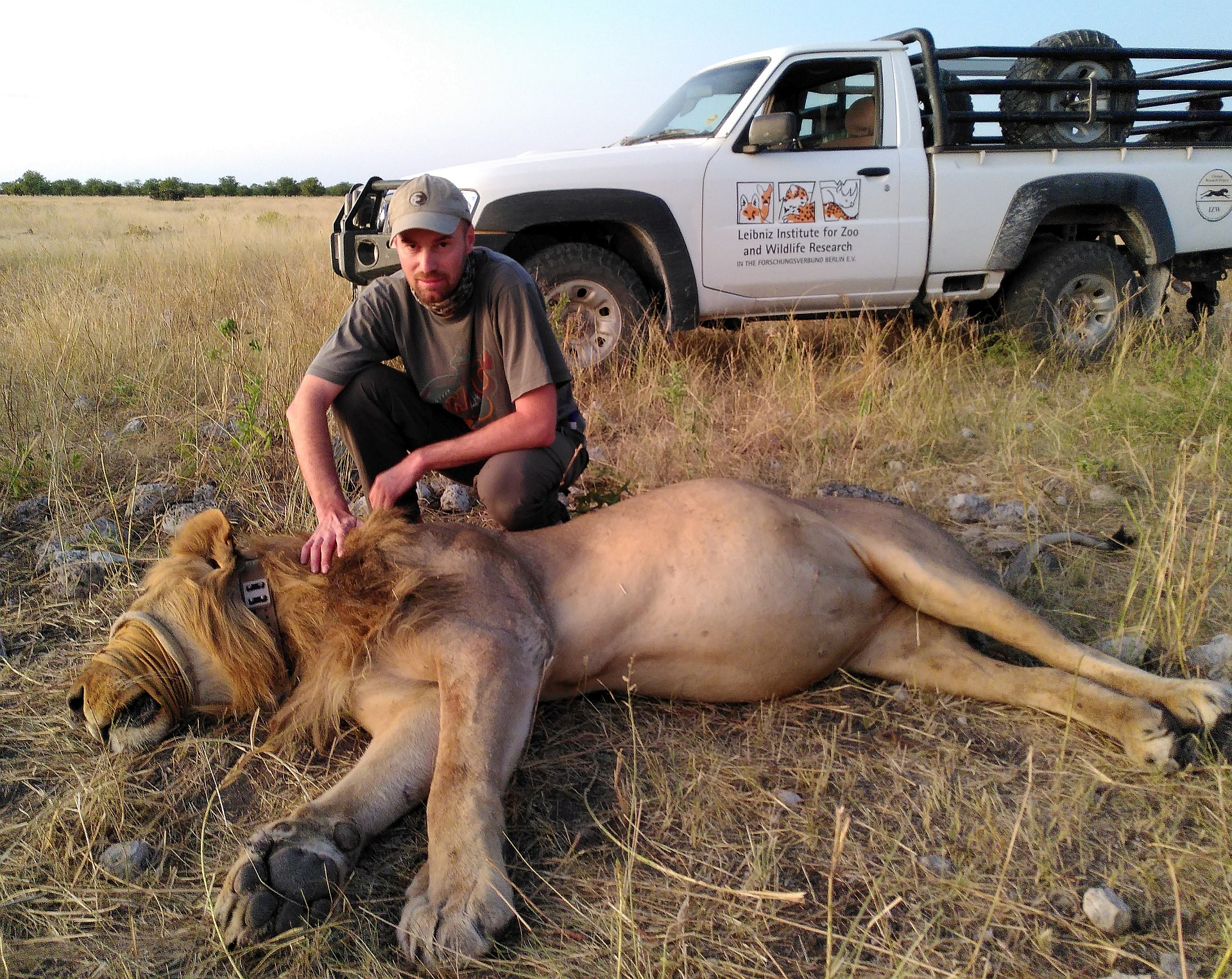
To achieve this, the Leibniz Institute for Zoo and Wildlife Research, in collaboration with the Fraunhofer Institute for Integrated Circuits (Fraunhofer IIS), developed a digital swarm in which natural swarm intelligence was virtually modelled within a network of microprocessors equipped with their own artificial intelligence. A specific application scenario involved tagged vultures in a cross-species network with tagged scavenging terrestrial mammals such as lions and hyenas. To this end, wild white-backed vultures and lions in Etosha National Park in Namibia were fitted with animal transmitters, and large amounts of GPS, ACC and audio data were collected. For the lions, an artificial neural network was developed and trained to interpret the animals’ behaviour from the transmitter data (e.g. feeding, roaring, running). In combination with a comparable AI model from the ‘GAIA-Sat-IoT’ project, which was developed for white-backed vultures, it was possible to investigate how an interspecific swarm might behave and what information can be derived from the animals’ collective behaviour (e.g. carcass localisation by vultures and terrestrial scavengers).
The complex algorithms, such as the GAIA AI models for behaviour classification or image recognition, were not processed centrally on a single device, but distributed across several devices in the vicinity of the Extreme Edge (digital swarm). To this end, ad hoc networks were established to connect the individual radio nodes within a network. As animal swarms operate in remote areas without terrestrial network coverage, it was also necessary to connect these local networks via satellite. This enables the information generated within this local AI network to be transmitted quickly and efficiently to users. The biological data collected and the AI models developed also formed the basis for an end-to-end simulation of networked animal transmitters in collaboration with Fraunhofer IIS.
The project “SyNaKI” was funded by the German Federal Ministry for Economic Affairs and Climate Action on the basis of a decision of the German Bundestag.
Consortium Partners: Leibniz Institute for Zoo and Wildlife Research (Leibniz-IZW) & Fraunhofer Institute for Integrated Circuits IIS
Duration: January 1, 2022 – June 30, 2024
Funding code: 50YB2202B